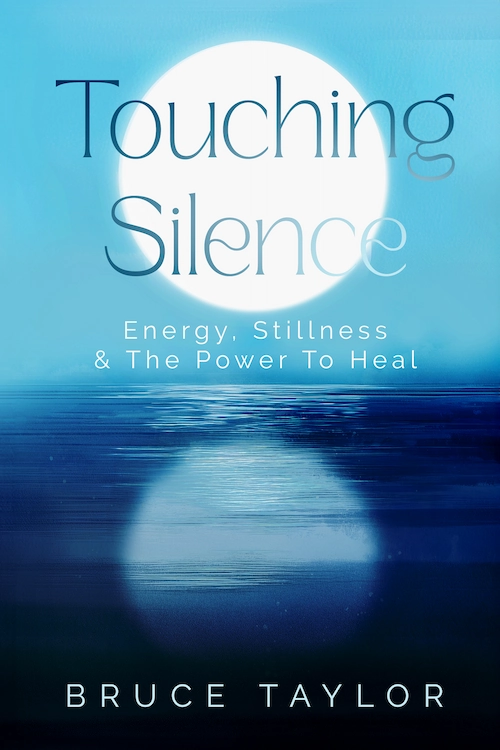
Touching Silence
Touching Silence is a guide to recognizing your life exactly as it is, and to finding the stillness present beneath every story and routine. Drawing from Zen practice, traditional Japanese Reiki Ryōhō, contemplative work with plant medicines, and clear-eyed reflections on physics and cosmology, the book follows the movement of energy from form into formlessness and back again.
Rather than offering quick fixes or spiritual slogans, the book walks patiently through the realities of suffering, illness, anxiety, and loss. It shows how attention, honest practice, and a willingness to sit in silence allow old patterns to unwind and the body, mind, and energy system to return to balance. Along the way, concepts like ego, trauma, time, and space are explored with both contemplative depth and rational clarity.
Inside, readers will explore:
- How routine, habit, and ego keep us moving outward instead of inward.
- The role of energy, the body, and Reiki Ryōhō in self-healing.
- Why suffering can become a teacher when met with presence.
- How ideas from quantum physics, Planck time, and cosmology can help ground experiences of stillness and expanded awareness.
- Practical ways to sit with resistance, work with fear, and allow space to open in ordinary life.
The book does not ask you to become someone different. It invites you to return, again and again, to the quiet field of awareness that is already here, and to let healing arise from that space.
For Readers of Touching Silence
If the book resonated and you want to explore the practice that grounds these ideas:
Learn Reiki Ryōhō: Learn authentic Reiki Ryōhō direct from the source
Practice together with a global community: Weekly Global Reiki Healing Circle
Join me on an upcoming pilgrimage: Retreats & pilgrimages
Questions? Email Me - I will reply to you directly as soon as I'm able.
What Readers Are Saying
Sample chapter
To give a clear sense of the voice and focus of the book, you can read the full first chapter below.
Read Chapter 1: The Nature of Our Being
Like a blank slate, we enter the world free from the weight of stories, beliefs, and identities. But as life unfolds, that slate fills with the marks of experience. Some marks are light and fleeting, others deep and enduring. Over time, these inscriptions shape how we see ourselves and the world around us. They become our routines, our habits, our ego.
And yet, beneath it all, the blank slate remains. Untouched. Waiting.
The journey of healing is not about erasing what has been written. It is about returning to that original space, the stillness that holds everything without judgment. It is about recognizing that the slate is still blank, even as life writes upon it.
This recognition is the hardest step. This is the crux of the problem. The prospect of introspection can be confronting. It is far easier to keep going, to stay with what we know, even if it is uncomfortable. Somewhere within, we believe that looking within risks disruption. That disruption is where freedom begins.
Because self-liberation cannot be found anywhere but within, and eventually, holding on to and clinging to old stories and survival patterns becomes more exhausting than the effort to release them. In that release, we are brought closer to the present moment itself, where form and formlessness meet, and the energy of life flows without the weight of what came before. At some point, the tension gives way. And in its place, space opens. The space of letting go.
Consider a simple but powerful example: the beliefs and patterns passed down from our parents. Our earliest understanding of life, what love is, how people should behave, and what to expect from the world is shaped by what we observe in those closest to us. These impressions land early, before we can question or discern.
From an early age, we absorb attitudes around love, marriage, family dynamics, conflict, expression, religion, gender roles, ambition, authority, and safety. These form the foundation of our internal worldview. They become part of the story we carry into adulthood.
Some of these stories may be beautiful. Others may be limiting, painful, or simply untrue. And it is those, the inherited fears, shames, and misunderstandings, that often drive our internal resistance. These are the places where we suffer, where our energy gets stuck, so to speak. These are the stories we must eventually meet, with honesty and compassion, so we can let them go.
Or perhaps we need to meet them with enough sustained compassionate consistency until we recognize that the believed fear of letting go always was only that, fear.
But sometimes, those stories feel too heavy. Too complex. Too entangled to untangle. Some patterns stretch across years, or even lifetimes, and sometimes these appear insurmountable.
And still, the work is the same: to return to what is true. To remember that under every story is the clean slate, still waiting for you to return and still calling you back home.
What forms the barrier between stillness and attachment?
It is the nature of self-preservation to seek safety and to avoid risk. But within those confines, our ability to grow and evolve becomes limited. The friction of change is often seen as too much, too threatening, too painful to bear.
This is where the ego steps in.
We often speak of the ego as if it is inherently harmful, but that is not entirely true. The ego is part of our being. It serves a function. It shelters us from suffering. It protects us from facing the parts of our story that feel too raw, too heavy to carry. In a way, the ego becomes a buffer, a safe zone that keeps us oriented toward what is familiar, even when what is familiar is no longer helpful.
Its safety lies not in truth, but in recognition. The ego organizes the world into a narrative we have come to know, whether it is nurturing or painful. It holds the version of ourselves we have had to become to survive.
Think of someone described as having a big ego, someone loud, dominating, constantly filling space. Why do they do this? Why spend so much energy constructing and defending that identity? If you look deeper, what you may find is fear. Beneath the projection of confidence is often the frightened child who never felt safe enough to be seen. A child who learned early on that the only way to feel in control was to perform, to impress, to avoid vulnerability at all costs.
So the ego steps in, not as an enemy, but as a defense. It says, let us not go there. Let us stay with what is known. And in doing so, it creates a wall between us and the stillness we long for.
This is the paradox. The ego protects us, but it also delays our healing. Like a bandage never removed, it covers the wound but prevents it from truly closing.
None of this makes the ego bad. It means that, at a certain point in our journey, we must stop treating the ego as our only truth. We must be willing to meet what lies beneath it. We must find the courage to sit still, to be fully present, and to turn inward, even if it feels uncomfortable or unfamiliar.
Just as we explored with routine in the prologue, constant motion and performance become distractions. They keep us from being with ourselves. True healing begins in stillness when the distractions fall away and all we are left with is ourselves, our inner self, our original self.
This is where transformation begins. Not by dismantling the ego through force or judgment, but by gently witnessing it. By acknowledging the ways it has kept us safe, and also the ways it has kept us stuck. To witness in this way is to step into the same stillness that underlies all healing. Over time, this stillness will reveal itself not just as a state of mind, but as the ground of being from which all movement, change, and renewal arise.
Only then can we begin to soften. To peel back the layers and approach the truth of who we are. Only then can we return to the blank slate, not as something we have lost, but as something that has been waiting for us all along.
Perhaps we realize this blank slate only twice in our lives: when we are born, and then once again re-examined and re-felt during death. If, at death, our life flashes before our eyes, we can hopefully come back to this blank slate, unwinding our suffering and trauma, our belief systems, and our ego. We can greet death with a clean slate.
Life gives us trials. We suffer resistance; we endure our pains and our victories. However, we can free ourselves from our narratives. We can turn inward. We can search for that blank slate and search for our true nature. There are several ways to achieve this, including meditation, mindfulness, yoga, and breathwork. We could take walks or write. We could begin therapy. Regardless of the path, we work to cultivate a seamless flow of energy through our bodies. All attachment creates resistance to this flow. To facilitate healing, it is essential to gain an understanding of energy, its dynamics, and its interconnectedness with all elements in the universe. This comprehension enables us to harness the flow of energy and use it in the healing process.